Grief Spotters
The day my sister Sarah died, I was planning on joining a video call with my book club friends. We’d been talking every week since early in the pandemic and had gotten together a couple of times in person to actually discuss books. I did NOT feel like joining the call and chatting. Nothing was important anymore. My sister had died. How could the earth still be turning?
I had a work meeting scheduled that day. When I called to cancel the meeting, the supervisor of the project asked me if I had anyone with me. I said no (my partner was in Nevada with his mom, who was being released from the hospital with COVID-related pneumonia) and told her I was going to skip book club. She told me to go, that I needed a spotter.
I was a cheerleader from 5th grade through college, often serving as the spotter myself. In cheerleading stunts, especially things like pyramids, you have three components: flyers, bases, and spotters. I rarely flew, preferring to be a base. I was often a spotter. The flyers are the ones who are lifted up and sometimes thrown into the air by the bases. Bases, therefore, do the lifting and tossing (no one is actually thrown). Being a base always made me feel so strong–I mean, I could basically lift a 115 pound person above my head. I loved the collective timing of creating a pyramid or doing a stunt during a cheer. You have to be in sync with the other bases, the beat of the music or chant, and using subtle physical cues with the flyer to pull off a successful stunt, especially if there are multiple layers of people or any times when the flyer is airborne.
I can’t say I always loved being a spotter. You’re in the back with your arms up for the length of the stunt, waiting for something to go wrong (you might also help in dismounts). It is a very important role to keep the other cheerleaders safe. Once, during college, I was spotting a heel stretch, where the base had a flyer on his shoulders and she lifted one foot up in her right hand, extending her arm out on a diagonal. She is standing on one foot with one leg in the air and the opposite arm completing the V shape. In this particular instance, the stunt was part of a cheer, so it moved quickly. The base was solid, the flyer hit the heel stretch perfectly, but a second later, she lost her center of gravity, and she fell to the side. It seemed like slow motion to me. My arms were up, I moved under her, and caught her safely. We were able to hop back into the cheer without missing a beat. Even though it was part of my job as a cheerleader, I was proud to do that job well. It’s scary whenever someone falls, and flyers fall from at least the height of another person.
Learning my sister died felt like falling through the deepest abyss (YiYun Li talks about this more elegantly and eloquently than I could ever in her book, Things in Nature Merely Grow, and on an “All There Is” podcast episode, and Aubrey Plaza aptly likens grief to the movie “The Gorge”). I wanted to be as close to the ground as possible. In my apartment, I would curl up on the floor and sob. Out walking, I would have the urge to fall down onto the grass or sidewalk. When I would talk about grief, my head felt heavy. I often rested it on the table. It felt like too much effort to stay upright.
My supervisor was right: a spotter was exactly what I needed. Someone to put their arms up in case I fell.
I joined the book-club call a bit late. I said, “I can’t talk, but I was wondering if anyone wanted to go for a walk later.” My friends could tell something was wrong, of course, and asked. I simply said: “My sister died.”
All three of my friends dropped what they were doing and came over. They fed me, held me, watched movies with me, made calls for me, let me cry, and simply loved me. I needed a spotter and I got three.
I am grateful for them and for the person who suggested I ask for help. I am grateful for the people who supported me and continue to support me in my grief. Cassie, Julie, and Rayla were the first to catch me when I didn’t even know what I needed.
Do you have spotters in your life? Who are they and how do they help? Are they the same people who caught you in the beginning of your grief? Have new or unexpected people stepped in since then?
If you aren’t sure who your spotters are, consider reaching out to me for grief support. We’ll explore where you can find the people waiting to catch you when you fall.
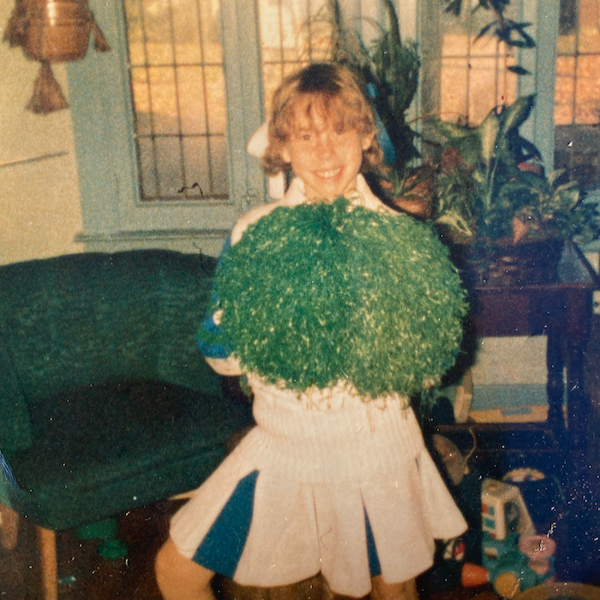
Me in my fist cheerleading uniform. Even though I was the second-shortest on the team, I was still a base and a spotter!